
How to Remove Limescale from a Toilet: The Complete Guide
Limescale in the toilet is one of the most stubborn cleaning problems: it forms dull, cloudy stains, yellowish deposits and build-up that resist scrubbing and, over time, trap dirt and bad odors. The good news is that it can be removed, even once it has hardened, by choosing the right method based on how thick the deposit is.
In short: to remove limescale from a toilet, apply an acidic product to the surface, let it sit for the required time, then finish with a toilet brush before flushing. For light limescale, household remedies such as vinegar or citric acid may be enough; for stubborn build-up, especially under the rim, you need a professional descaling gel such as Nettuno’s N1, which clings to vertical surfaces and dissolves even the most resistant deposits — making everyday cleaning more effective as well.
Why Limescale Forms in the Toilet
Limescale is a deposit of calcium and magnesium salts found in water. The harder the water (i.e., the richer in these minerals), the faster it builds up. In the toilet, the phenomenon is intensified by two factors: water sits in the lower part of the bowl, and it always flows along the same points under the rim, where it evaporates and leaves mineral residue that builds up in layers. Organic and urine residues add to this, combining with limescale to create hard, foul-smelling build-up.
Regular treatment prevents deposits from hardening: the longer they are left, the thicker and harder to remove they become. What’s more, a limescale-encrusted surface is rough and porous, trapping dirt and residue more easily and reducing the effectiveness of everyday cleaning, which struggles to work on a surface that is already compromised. Removing limescale periodically therefore makes daily cleaning genuinely effective, rather than a wasted effort.
How to Remove Limescale from a Toilet: The Methods
The right method depends on how severe the build-up is.
Household remedies (light limescale)
For recent, thin limescale, household acidic solutions such as warm white vinegar or citric acid dissolved in water can work: pour onto the surface, let sit, then scrub with a toilet brush. These are useful for occasional maintenance, but with a limitation: on thick, layered build-up or under the rim, they act slowly and often incompletely, because the liquid runs off before it can stay in contact long enough. In restrooms that are numerous and heavily used, faster and more effective products are needed.
An important warning: never mix these with bleach or chlorine-based products. Combining an acid with chlorine releases gases that are hazardous to health.
Professional descaling gel (stubborn build-up)
When limescale has hardened, turned yellowish or concentrated under the rim, the most effective solution is a professional descaling gel. The gel formulation is key: unlike a liquid, it clings to the vertical walls of the bowl and stays in contact with the build-up for the entire dwell time, working where liquid remedies cannot reach.
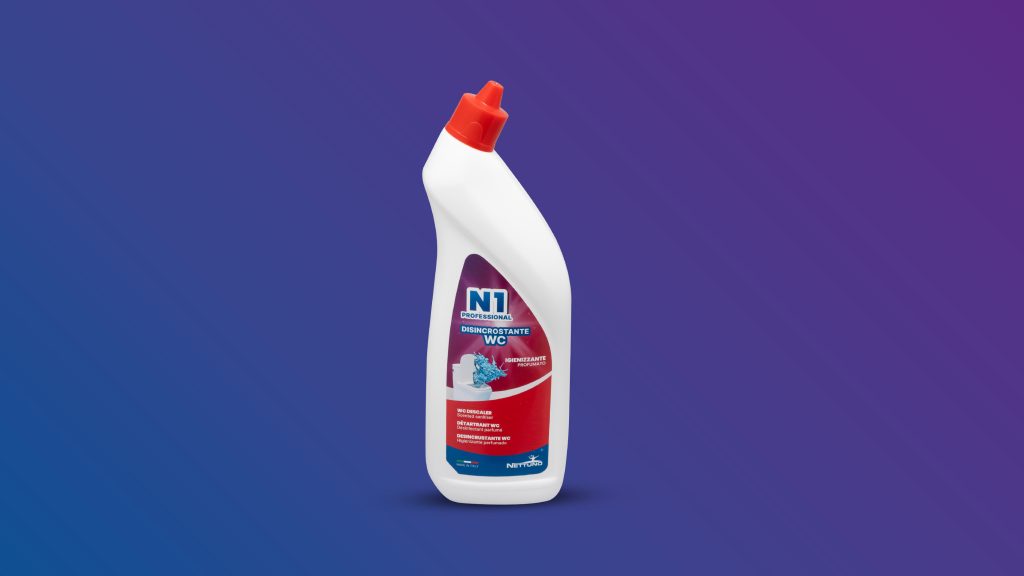
N1, Nettuno’s limescale-removing gel for toilets, was developed for exactly this purpose: a fragranced, acidic gel (pH 1-2) that sanitizes and removes the most resistant limescale build-up and urine residue from toilets, urinals and other fixtures, leaving surfaces clean, shiny and pleasantly, lastingly fragranced. Precisely because of this concentrated descaling action, N1 is not designed for daily use, but for targeted treatments against build-up, to be repeated as often as water hardness requires. In doing so, it clears away the layer of limescale that would otherwise undermine the effectiveness of subsequent everyday cleaning. N1 is part of the NetPro range of professional bathroom and surface cleaners.
How to Remove Limescale from a Toilet Step by Step with N1
- Apply the gel under the rim. Using the duck-bill applicator nozzle, apply N1 under the rim of the bowl and directly onto the areas of build-up, making sure the gel adheres to the walls.
- Let it work. Keep the lid raised and let the product act for the required time. For the toughest deposits, you can leave it to work overnight.
- Scrub with the toilet brush. The mechanical action of the brush helps remove the softened build-up and helps eliminate bad odors.
- Flush. Flush with running water to wash away the product and the dissolved residue.
The result is a clean, shiny, sanitized bowl, with a pleasant floral note that lingers in the air. For bathroom surfaces other than the toilet, you can complete the cleaning with the other products in the range, such as N2 for fixtures and N3 for shower enclosures and taps.
Limescale Under the Rim and Tougher Build-Up
The area under the rim is the most critical, because it is hard to see, difficult to reach with a brush, and precisely where water flows and leaves the most deposits. This is where the gel performs best: applied directly under the rim, it stays in place and works on the build-up without dripping away. For very thick deposits, it is worth repeating the application and extending the dwell time — ideally leaving the product to work overnight, when the toilet is not in use.
Professional Toilet Descaler: Where It Makes the Difference
In high-traffic restrooms, limescale re-forms quickly and cleaning time is limited: this is where a professional descaler has a real impact on performance, speed and cost per clean. N1 is designed for those managing cleaning in shared facilities and sites with multiple restrooms, such as:
- hospitality venues, bars and restaurants;
- gyms, swimming pools and sports centers;
- offices, schools and community facilities;
- nursing homes and healthcare facilities;
- industrial sites and production plants.
The professional 750 ml format with duck-bill applicator and the concentrated gel formula optimize dosage and application time, benefiting anyone who cleans multiple restrooms every day. Even in these high-frequency-use settings, N1 remains a periodic anti-limescale treatment, to be scheduled as needed and combined with daily cleaning.
Precautions and Mistakes to Avoid
- Do not use on marble, enameled metals or surfaces sensitive to acids: contact may cause irreversible damage. If in doubt, test first on a small, hidden area.
- Do not mix with bleach or chlorine-based products: the reaction between acid and chlorine releases harmful gases.
- Respect the recommended dwell time and ventilate the room during use.
- Do not use for daily cleaning: as a concentrated acidic descaler, frequent use can damage the toilet’s enamel and metal parts over time.
- Store the product out of reach of children and always follow the instructions on the label.
Descaling and Sanitizing: Two Actions in One Step
Removing limescale isn’t just about looks. Build-up traps dirt, bacteria and bad odors, so a limescale-free bowl is also more hygienic. N1 combines both actions: it removes build-up and sanitizes the surface. To understand the difference between cleaning, sanitizing and disinfecting (and when each is needed), see our article on the difference between a sanitizer and a disinfectant.
Professional Bathroom Cleaning with Nettuno
A limescale-free toilet looks better, is more hygienic and easier to maintain — especially in shared facilities where restrooms are numerous and heavily used. With the N1 descaling gel and Nettuno’s range of bathroom and surface cleaners, businesses and cleaning companies have professional solutions for every need. Explore the range or contact our experts for dedicated advice.